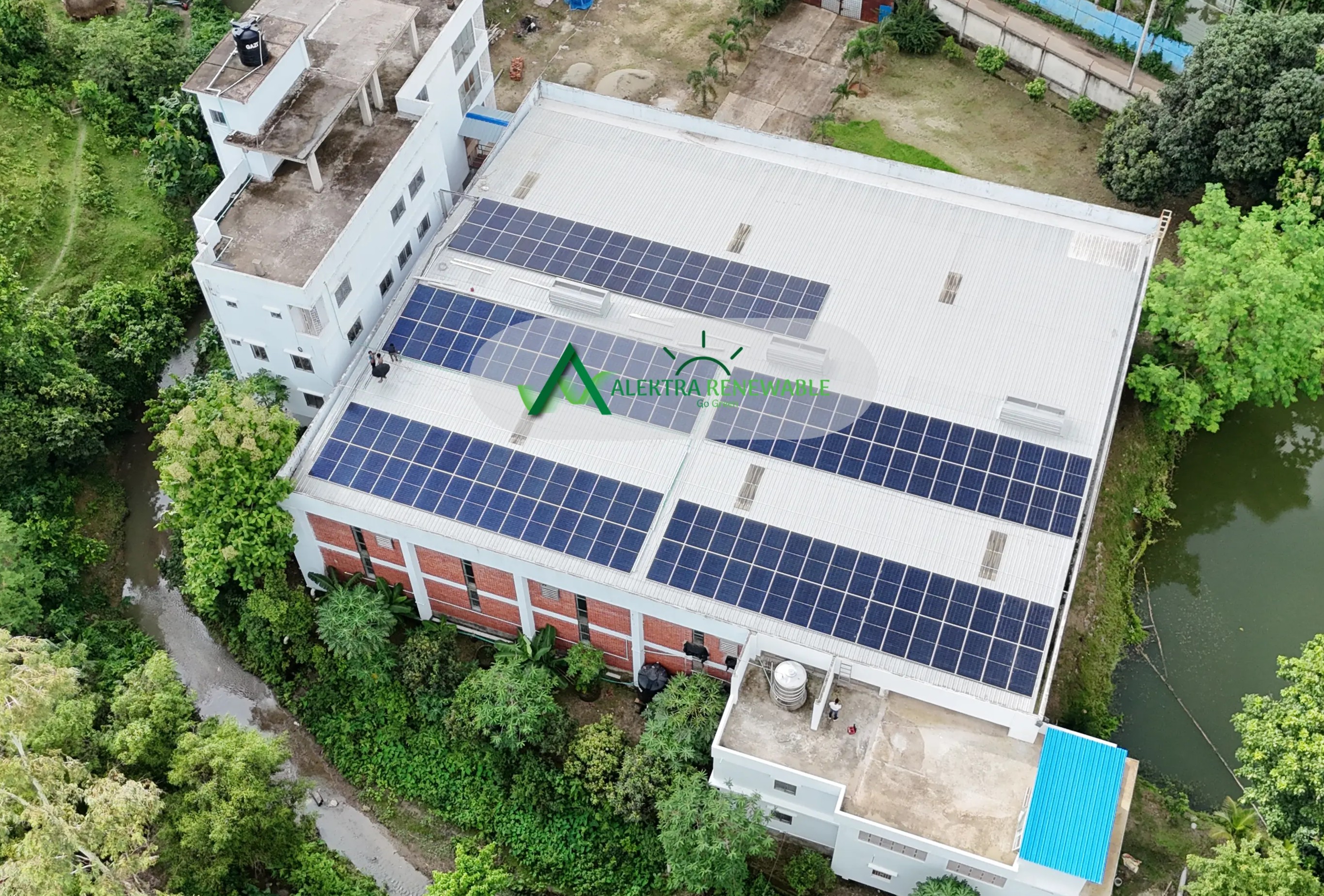
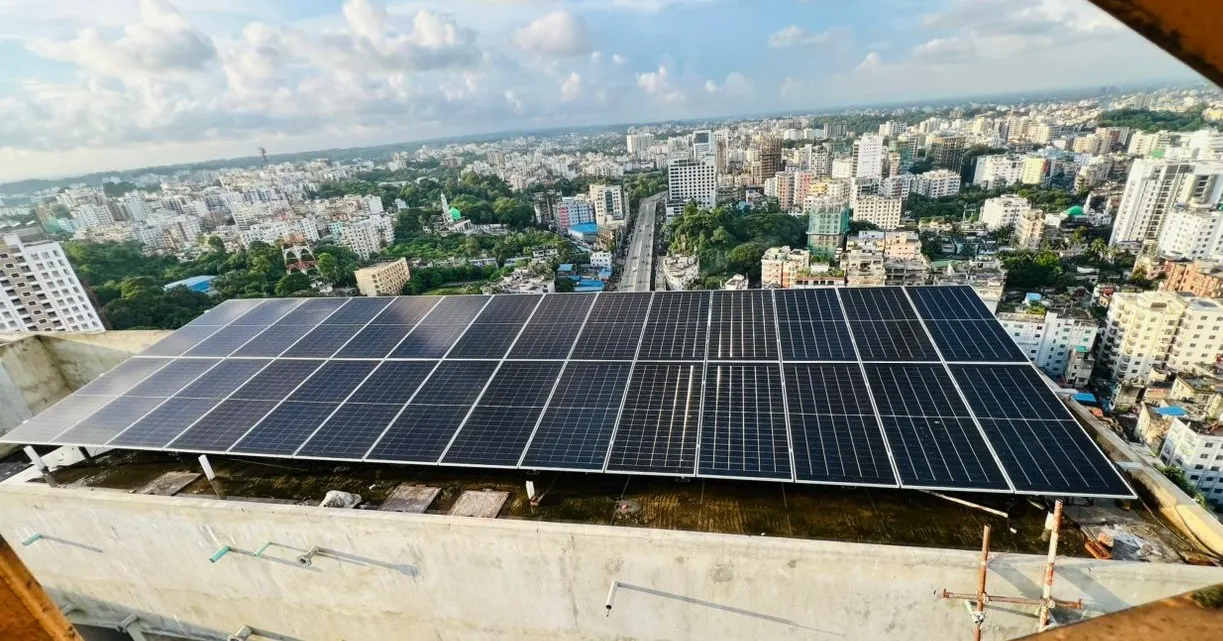
40.26 kWp High-Rise Rooftop Solar Project at Meridian Kohinoor City, Chattogram
Alektra Renewable designed and implemented a 40.26 kWp grid-connected rooftop solar PV system for Meridian Kohinoor City, located at Dampara, WASA, Chattogram, Bangladesh.
Meridian Kohinoor City is a prominent 22-storey shopping and commercial complex in the heart of Chattogram City. Installing a solar PV system at this height required greater attention to structural safety, wind exposure, mounting strength and long-term durability than a conventional low-rise rooftop installation.
Solar PV System Configuration
The project has a total installed DC capacity of 40.260 kWp, consisting of:
- 66 × JA Solar JAM66D45-610/LB 610 Wp modules
- N-type bifacial solar module technology
- 1 × Solis S5-GC50K 50 kW three-phase on-grid inverter
- Custom hot-dip galvanized steel mounting structure
The 66 JA Solar modules provide a combined installed capacity of:
66 × 610 Wp = 40.260 kWp
The high-power n-type bifacial modules allow efficient utilization of the available rooftop area while providing a durable module platform for long-term commercial solar generation.
50 kW Solis On-Grid Inverter for Future Expansion
The solar plant uses a Solis S5-GC50K 50 kW on-grid inverter.
Although the currently installed solar capacity is 40.26 kWp, the 50 kW inverter was selected to provide additional flexibility for future expansion of the rooftop PV array, subject to the final future string configuration, inverter operating limits and engineering assessment.
This approach gives Meridian Kohinoor City the opportunity to increase its solar generation capacity in the future without necessarily replacing the main inverter.
High-Rise Solar Structural Engineering
One of the most important aspects of the Meridian Kohinoor City solar project was the height of the installation.
Because the solar array is installed on the rooftop of a 22-storey high-rise building, the mounting structure can experience substantial wind pressure, suction and uplift forces. Wind effects on an elevated rooftop can be significantly more demanding than those encountered on a typical industrial shed or low-rise commercial building.
Alektra Renewable's engineering team therefore carried out the necessary structural and wind-load calculations before finalizing the mounting arrangement.
The engineering assessment considered factors including:
- Building height and rooftop exposure
- Wind pressure and uplift forces
- Module-array geometry
- Structural-member spacing
- Connection strength
- Load transfer through posts, rafters and purlins
- Module clamping arrangement
- Long-term structural stability
The objective was to develop a mounting system capable of safely transferring environmental loads from the solar modules into the supporting building structure.
Heavy-Duty Hot-Dip Galvanized Mounting Structure
A robust hot-dip galvanized steel mounting structure was used for the rooftop solar array.
The principal structural members include:
- Post: 100 × 50 mm channel, 5 mm thickness
- Purlin and Rafter: 75 × 38 mm U-channel, 5 mm thickness
- Module Fixing: Aluminium mid clamps and end clamps
Hot-dip galvanization was selected to provide strong corrosion resistance and improve the long-term durability of the structure in Chattogram's humid environmental conditions.
The heavy-duty structural sections, combined with properly engineered connections and aluminium module clamps, provide a secure foundation for the solar array on the high-rise rooftop.
Renewable Energy Contribution
The 40.26 kWp rooftop solar power plant allows Meridian Kohinoor City to generate clean electricity directly from an otherwise unused rooftop area.
Based on an indicative specific solar yield of approximately 1,270 kWh/kWp per year, the system has the potential to generate approximately:
51,000 kWh of renewable electricity annually
This clean-energy generation can reduce the building's dependence on grid electricity and offset a portion of the electricity consumed during daytime operation.
Using an indicative Bangladesh grid-emission factor, this level of solar generation can avoid approximately:
31 tonnes of CO₂ emissions per year
Actual annual solar generation and carbon savings will vary depending on solar irradiation, module temperature, shading, soiling, system availability and operating conditions.
Turning a High-Rise Rooftop into a Clean-Energy Asset
The Meridian Kohinoor City project demonstrates the potential of commercial rooftop solar in dense urban areas such as Chattogram.
High-rise buildings present unique engineering challenges, particularly in relation to wind loading and structural safety. With proper engineering calculations, suitable mounting materials and professional installation practices, these rooftops can be transformed into productive renewable-energy assets.
For Meridian Kohinoor City, Alektra Renewable combined JA Solar n-type bifacial modules, a Solis commercial on-grid inverter and a custom-engineered hot-dip galvanized mounting structure to create a reliable rooftop solar installation designed for long-term operation.
The project represents Alektra Renewable's approach to commercial and industrial solar EPC:
Efficient Solar Generation. Sound Engineering. Structural Safety. Long-Term Reliability.