The Client’s Energy Requirement
Q&Q Foods Limited required more than a standard on-grid solar installation.
The facility needed a solution that could reduce electricity purchased from the utility grid while also maintaining the necessary backup capacity for designated electrical loads during grid outages.
A conventional on-grid solar plant can significantly reduce daytime electricity consumption. However, for safety reasons, a standard grid-tied inverter normally shuts down when the utility grid becomes unavailable. This means that solar energy alone does not automatically provide backup power during an outage.
To address both electricity-cost reduction and energy resilience, Alektra Renewable designed a system that combines a commercial on-grid solar inverter with a dedicated hybrid inverter and battery energy storage system.
100 kWp Solar PV System
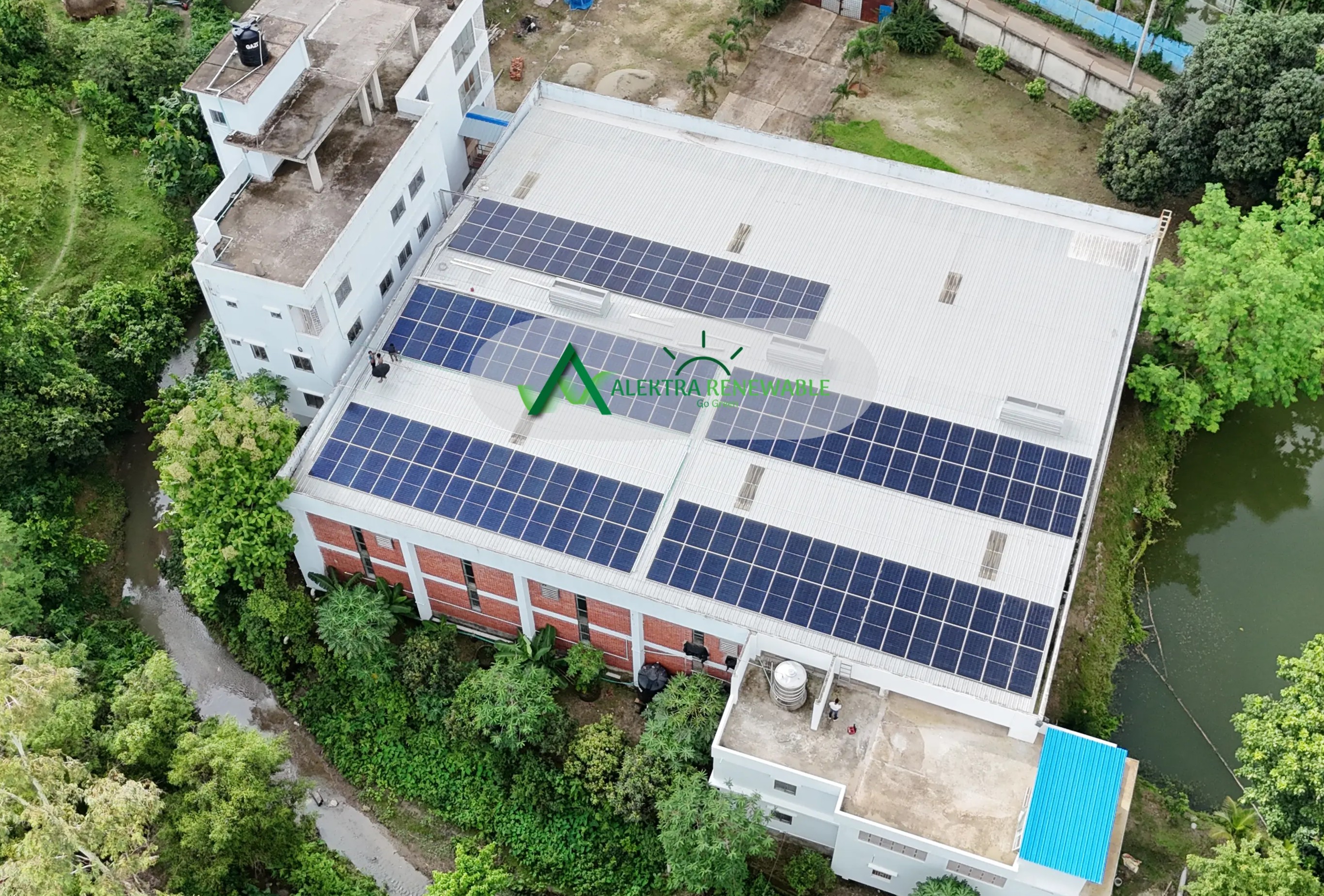
The project includes a total installed solar capacity of 100 kWp.
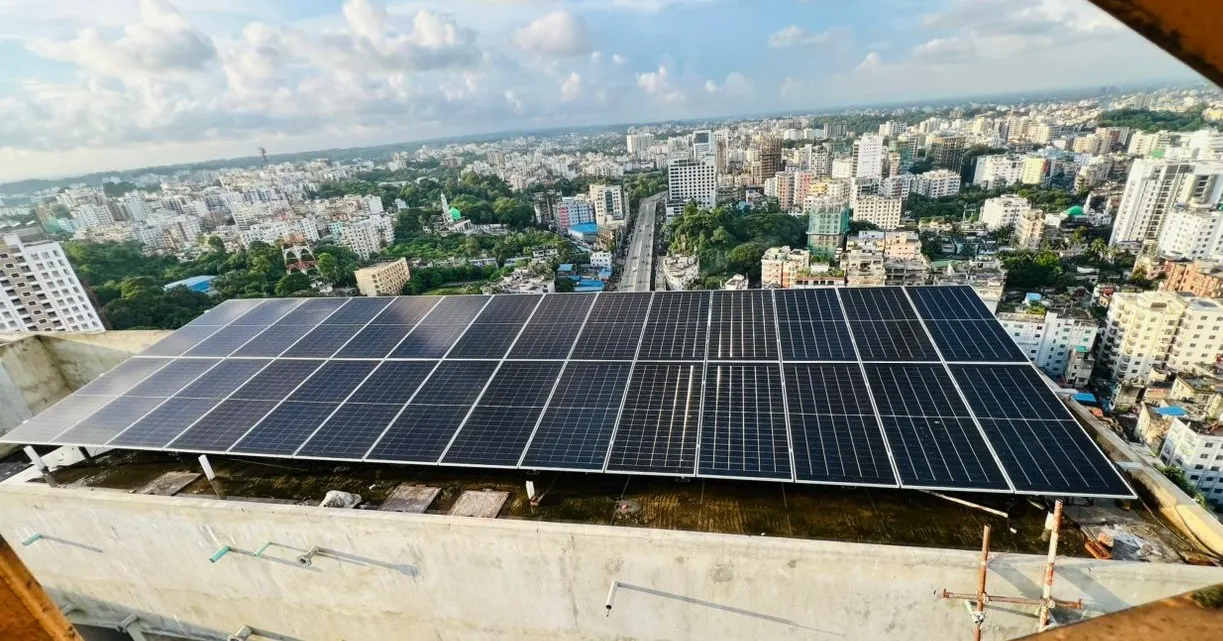
The rooftop solar array generates clean electricity during daylight hours, helping reduce the amount of energy that Q&Q Foods Limited needs to purchase from the grid.
The generated solar energy can be used to support the facility’s operating loads, while the integrated hybrid and battery system provides additional energy-management and backup functionality.
The system uses 625 Wp JA Solar n-type TOPCon bifacial modules, selected for their high power density, strong conversion efficiency and suitability for commercial and industrial rooftop applications.
JA Solar 625 Wp N-Type TOPCon Bifacial Modules
The solar array was constructed using JA Solar 625 Wp n-type TOPCon bifacial modules.
N-type TOPCon technology offers several technical advantages for industrial solar projects, including:
- High module efficiency
- Strong performance under elevated operating temperatures
- Improved low-light energy generation
- Lower long-term degradation
- Better energy yield over the operating life of the system
- Bifacial energy-generation capability
- High power output from a limited rooftop area
The bifacial module design allows the rear surface of the module to receive reflected irradiance where suitable site conditions are available. Actual rear-side energy gain depends on roof reflectivity, module elevation, array spacing and surrounding conditions.
For an industrial rooftop where available installation area must be used efficiently, the 625 Wp module rating allows a higher total capacity to be installed with fewer individual modules than lower-wattage alternatives.
50 kW Solis On-Grid Inverter
A Solis S6-GC3P50K-NV-ND 50 kW on-grid inverter forms the grid-connected generation section of the system.
This inverter converts the DC electricity produced by its associated solar array into three-phase AC electricity that can be used by the facility.
During normal daytime operation, solar power directly offsets a portion of the electricity that would otherwise be imported from the utility grid.
The on-grid inverter contributes to:
- Daytime electricity-cost reduction
- Improved use of available rooftop solar capacity
- Three-phase commercial power conversion
- Real-time system monitoring
- Controlled and protected grid interaction
- Long-term solar energy production
- 50 kW Solis Hybrid Inverter
The project also incorporates a Solis S6-EH3P50K-H 50 kW three-phase hybrid inverter.
The hybrid inverter provides the interface between the solar generation system, battery energy storage, facility loads and the electrical grid.
Its inclusion enables the project to perform functions that a conventional on-grid solar system cannot provide independently.
Depending on the approved configuration and operating strategy, the hybrid system can support:
- Battery charging from available solar energy
- Controlled battery discharge
- Backup supply for designated loads
- Energy shifting between different operating periods
- Reduced dependence on grid electricity
- Improved energy resilience
- Monitoring of solar, battery, grid and load conditions
The 50 kW hybrid inverter and 50 kW on-grid inverter provide a combined inverter capacity of 100 kW.
80 kWh Solis FlexCore-ID Energy Storage System
Energy storage is provided through a newly released SolisStorage FlexCore-ID system configured at 80 kWh.
The battery system stores electrical energy for later use. This allows Q&Q Foods Limited to retain backup capacity for selected loads instead of relying exclusively on real-time solar generation or utility availability.
The battery system can be charged when suitable energy is available and discharged according to the programmed operating strategy.
The 80 kWh storage capacity supports the project’s energy-resilience objective by helping:
- Maintain designated backup loads during outages
- Store surplus or allocated solar energy
- Reduce dependence on grid power
- Improve continuity for important operations
- Support controlled energy use during selected periods
- Provide a foundation for intelligent commercial energy management
The exact backup duration depends on the connected load.
For example, an 80 kWh battery will not provide the same operating duration for a 10 kW load as it would for a 40 kW load. Actual usable backup time is affected by the permitted battery depth of discharge, conversion efficiency, battery reserve setting and variations in the connected load.
For this reason, Alektra Renewable designs the backup distribution around identified critical loads rather than assuming that every load in the facility must operate continuously from the battery.
Why an AC-Coupled System Was Selected
The Q&Q Foods project uses an AC-coupled system architecture.
In an AC-coupled arrangement, the on-grid solar inverter and the hybrid energy-storage system are integrated on the AC side of the facility’s electrical network.
This structure allows the grid-tied solar plant and the battery-storage system to perform their respective functions while remaining part of one coordinated energy solution.
The AC-coupled design offers several advantages for commercial facilities:
Integration of on-grid solar and battery storage
Flexible distribution of inverter capacity
Separation of grid-tied and backup functions
Easier expansion of an existing or future solar system
Independent monitoring of system sections
Improved operational flexibility
Practical maintenance and troubleshooting
Compatibility with commercial three-phase electrical systems
The on-grid inverter primarily supports solar generation and electricity-cost reduction, while the hybrid inverter manages battery charging, discharging and backup operation.
Backup Power for Essential Loads
One of the main objectives of the project was to provide Q&Q Foods Limited with necessary backup capacity.
The battery system is not intended merely as a visual addition to the solar plant. It forms an operational part of the facility’s electrical resilience strategy.
During a grid interruption, the hybrid inverter and battery system can supply designated backup loads according to the approved electrical configuration.
Critical-load selection is particularly important in industrial and commercial facilities. Essential equipment should be separated from large, non-critical or high-inrush loads wherever necessary so that available battery energy can be used effectively.
A well-designed backup distribution system may prioritize loads such as:
Control and monitoring equipment
Essential lighting
Communication systems
Selected office equipment
Security systems
Critical process controls
Other approved operational loads
Actual backup capability depends on the final load allocation and operating conditions.
L-Foot and Long Aluminium Rail Mounting System
The rooftop mounting structure uses an L-foot system with long aluminium rails.
This type of mounting arrangement provides a strong and organized support platform for the solar modules while distributing loads along the rooftop structure.
The long-rail configuration supports:
Accurate module alignment
Consistent row formation
Secure mechanical attachment
Controlled transfer of structural loads
Easier cable routing
Improved installation quality
Better long-term maintainability
The mounting system was designed with consideration for module layout, roof condition, structural attachment, drainage paths and environmental exposure.
Multi-Layer Rooftop Waterproofing
Waterproofing was treated as a critical engineering requirement.
Improperly sealed mounting penetrations can create long-term leakage risks, particularly during heavy rainfall. To reduce this risk, Alektra Renewable used a multi-layer waterproofing approach incorporating:
EPDM
Silicone sealant
Butyl tape
EPDM provides a resilient sealing layer around the mounting interface. Butyl tape creates an additional water-resistant barrier, while silicone sealant is applied where appropriate to complete and reinforce the sealing arrangement.
The objective was to protect the roof penetration point through multiple complementary sealing layers rather than relying on only one material.
The installation team also considered existing roof drainage paths so that the solar mounting system would not obstruct the natural flow of rainwater.
Hot-Dip Galvanized Cable Tray
The project uses hot-dip galvanized cable trays for organized and protected cable routing.
Industrial rooftop environments expose electrical cables to heat, ultraviolet radiation, moisture, wind and mechanical stress. Leaving cables loosely installed across the roof can create maintenance, safety and reliability problems.
The HDG cable-tray system provides:
Structured cable routing
Improved mechanical protection
Better support for long cable runs
Resistance to corrosion
Easier inspection and maintenance
Separation of relevant electrical circuits
A cleaner and more professional installation
Reduced risk of cable movement or abrasion
Proper cable management is one of the clearest differences between a temporary-looking installation and a professionally engineered industrial solar plant.
Solar Module Cleaning System
A dedicated cleaning arrangement was incorporated into the project to support long-term energy production.
Dust, pollution, bird droppings and other deposits can reduce the amount of sunlight reaching the solar cells. In industrial areas, soiling can become a significant source of energy loss if the modules are not cleaned according to an appropriate maintenance schedule.
The cleaning system helps the facility’s maintenance team carry out periodic cleaning more safely and consistently.
The required cleaning frequency should be determined by:
Local dust conditions
Seasonal weather
Rainfall
Nearby industrial activity
Roof accessibility
Measured performance loss
Manufacturer recommendations
Cleaning should be performed using suitable methods that do not scratch the module glass, damage seals or expose personnel to unnecessary electrical and fall hazards.
Earthing and Lightning Protection
The system was implemented with proper earthing and lightning-protection measures.
A rooftop solar plant contains extensive metallic structures, long DC cable routes and sensitive power-electronic equipment. These components must be properly integrated into the facility’s electrical protection system.
The protection arrangement includes suitable consideration for:
Module-frame bonding
Aluminium rail bonding
Mounting-structure earthing
Inverter earthing
Cable-tray bonding
DC surge protection
AC surge protection
Equipment grounding
Integration with the facility’s lightning-protection system
Safe fault-current paths
Lightning protection and surge protection are related but separate functions. The external lightning-protection system manages direct strike risk, while surge-protection devices help limit transient overvoltage reaching sensitive electrical equipment.
A coordinated protection design is therefore necessary for long-term system safety and reliability.
Electricity-Cost Reduction
The 100 kWp solar array allows Q&Q Foods Limited to generate a portion of its electricity directly from sunlight.
Whenever solar generation is available and the facility is consuming electricity, the solar energy can offset grid imports. This reduces the number of kilowatt-hours purchased from the utility.
The actual financial savings depend on:
Annual solar irradiation
Module orientation and tilt
Rooftop shading
System availability
Module temperature
Soiling and cleaning frequency
Inverter efficiency
Facility load profile
Utility electricity tariff
Export or net-metering arrangements
Battery charging and discharging strategy
The greatest direct-consumption benefit normally occurs when the facility’s daytime demand closely matches the solar-generation profile.
Energy Resilience Through Battery Storage
The 80 kWh ESS adds a second dimension to the project.
Solar generation provides economic value by reducing grid electricity consumption, while battery storage provides operational value by retaining energy for later use.
This means Q&Q Foods Limited can benefit from:
Lower grid electricity consumption
Backup capacity for designated loads
Improved control over energy use
Greater resilience during outages
Better utilization of available solar energy
Reduced operational exposure to grid interruptions
This combination makes the system more valuable than a conventional solar installation focused solely on electricity-bill savings.
Monitoring and Energy Visibility
The Solis inverter ecosystem provides monitoring capability for the major operating parameters of the system.
Depending on the final communication and metering configuration, authorized personnel can review information such as:
Current solar power
Daily energy generation
Historical generation
Grid import and export
Battery state of charge
Battery charging power
Battery discharging power
Hybrid inverter operating status
On-grid inverter operating status
System alarms and warnings
Load consumption trends
This visibility helps the client evaluate performance, identify irregularities and make informed energy-management decisions.
Engineering Quality and Long-Term Maintainability
The long-term performance of a solar and battery project depends on more than the equipment brand.
Installation quality, cable routing, waterproofing, structural attachment, system protection, commissioning and maintenance access all influence reliability.
For the Q&Q Foods Limited project, Alektra Renewable focused on:
Efficient rooftop use
Secure module mounting
Multi-layer waterproofing
Professional cable management
Suitable electrical protection
Backup-load planning
Safe maintenance access
Long-term serviceability
Clear separation of system functions
Coordinated solar and battery operation
These considerations help ensure that the project remains safe, accessible and manageable throughout its operating life.
Project Outcome
The completed system provides Q&Q Foods Limited with a modern commercial energy platform consisting of:
100 kWp of rooftop solar capacity
50 kW of on-grid inverter capacity
50 kW of hybrid inverter capacity
100 kW of combined inverter capacity
80 kWh of battery energy storage
AC-coupled system integration
High-efficiency n-type TOPCon bifacial modules
Commercial backup capability
HDG cable-management infrastructure
A rooftop module-cleaning arrangement
Multi-layer roof waterproofing
Coordinated earthing and lightning protection
The project allows Q&Q Foods Limited to reduce electricity costs while maintaining necessary backup capacity for selected loads.
It demonstrates how industrial solar, hybrid power conversion and battery storage can be combined within one carefully engineered solution.
Conclusion
The Q&Q Foods Limited project represents a practical transition from conventional rooftop solar to integrated commercial energy management.
By combining a 100 kWp solar plant, 50 kW Solis on-grid inverter, 50 kW Solis hybrid inverter and 80 kWh Solis FlexCore-ID battery system, Alektra Renewable developed a solution that addresses both energy cost and operational continuity.
The JA Solar 625 Wp n-type TOPCon bifacial modules provide high-efficiency solar generation. The on-grid inverter converts solar energy for immediate facility use, while the hybrid inverter and battery system provide energy-storage and backup functionality.
Supporting systems—including the L-foot and long aluminium rail structure, EPDM, silicone and butyl-tape waterproofing, HDG cable trays, module-cleaning arrangement and coordinated lightning protection—were implemented to support safety, durability and long-term performance.
For Q&Q Foods Limited, the project is not only a renewable-energy installation. It is a complete commercial energy solution designed to deliver:
Lower electricity costs. Necessary backup capacity. Improved energy resilience.
About Alektra Renewable
Alektra Renewable provides engineering, procurement and construction services for commercial and industrial solar PV, hybrid power and battery energy-storage projects in Bangladesh.
Our services include:
Rooftop solar PV systems
On-grid solar solutions
Hybrid solar systems
Commercial battery energy storage
Electrical system integration
Industrial energy assessment
Solar monitoring
Earthing and lightning protection
Testing and commissioning
Preventive maintenance
Aerial thermal inspection
Solar-module cleaning
Drone mapping and asset documentation
We design each project according to the client’s load profile, operational requirements, rooftop condition, electrical infrastructure and long-term energy objectives.
Frequently Asked Questions
What is the capacity of the Q&Q Foods solar project?
The project has a total installed solar PV capacity of 100 kWp.
What inverter capacity was installed?
The project uses one 50 kW Solis on-grid inverter and one 50 kW Solis hybrid inverter, providing a combined inverter capacity of 100 kW.
How much battery storage was installed?
The system includes an 80 kWh SolisStorage FlexCore-ID battery energy storage system.
Is the Q&Q Foods system on-grid or hybrid?
It is an AC-coupled solar and hybrid energy-storage system. It combines a commercial on-grid inverter with a hybrid inverter and battery storage.
Does the system provide backup power?
Yes. The hybrid inverter and 80 kWh battery system provide backup capability for designated loads according to the approved electrical design and available battery state of charge.
Which solar modules were used?
The project uses JA Solar 625 Wp n-type TOPCon bifacial modules.
How was rooftop leakage risk addressed?
Alektra Renewable used a multi-layer waterproofing arrangement incorporating EPDM, silicone sealant and butyl tape around the mounting interfaces.
Why were HDG cable trays used?
Hot-dip galvanized cable trays provide organized cable routing, corrosion resistance, mechanical protection and easier long-term maintenance.
What is the main benefit of the project?
The project helps Q&Q Foods Limited reduce electricity costs while maintaining necessary backup capacity and improving overall energy resilience.
Recommended Social Sharing Description
Alektra Renewable has completed a 100 kWp AC-coupled solar and battery energy-storage project at Q&Q Foods Limited. The system combines a 50 kW Solis on-grid inverter, a 50 kW Solis hybrid inverter, JA Solar 625 Wp n-type TOPCon bifacial modules and an 80 kWh Solis FlexCore-ID ESS—delivering both electricity-cost savings and essential backup capacity.